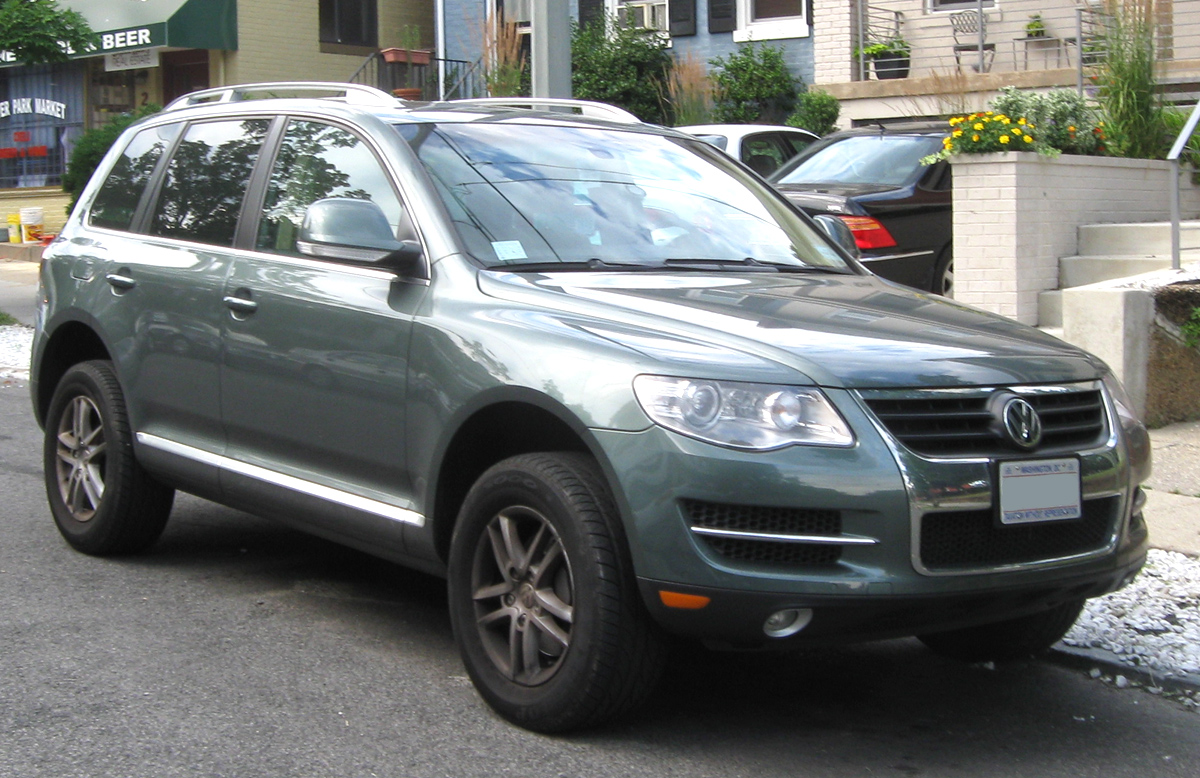
The Volkswagen Touareg is a mid-size crossover SUV produced by German automaker Volkswagen since 2002. It was the third sport utility vehicle from the automaker, after the much older Volkswagen 181 "Kurierwagen", and the Iltis (later produced by Bombardier). One even holds the world record for the heaviest load towed by a passenger car, pulling a Boeing 747 as part of an advertising campaign.The correct German pronunciation is [ˈtuːaʁɛɡ]. Volkswagen produced several commercials to assist people in using the correct pronunciation. The vehicle was named after the Tuareg people, a Berber-speaking group in North Africa. The name Touareg was first used for an automobile with the 1996 Peugeot Touareg concept car. The Touareg (internally designated Typ 7L) was a joint venture project developed by Volkswagen Group, who also include Audi, and Porsche, who were also looking to add a luxury-type SUV to its lineup, as a cost-sharing initiative. The goal was to create an off-road vehicle that could handle like a sports car. The team, with over 300 people, was led by Klaus-Gerhard Wolpert, and was based in Weissach im Tal, Germany. The result of the joint project is that the Porsche Cayenne shares the Touareg's Volkswagen Group PL71 platform, although there are styling, equipment, and technical differences between the two vehicles. The Volkswagen Touareg is built in Bratislava, Slovakia. The manufacturing plant shares production with Touareg-cousins, the Porsche Cayenne, and the Audi Q7. Due to the demand, and the exchange rates of euros against the US dollar, as well as different pricing and environmental policies in the USA, the V6 and V8 engine variants make up most of Volkswagen's American Touareg offering. However, a limited number of the V10 Turbocharged Direct Injection (TDI) diesel engines were available in the 2004 model year (before being pulled for environmental reasons). They were brought back to the United States for the 2006 as a "Tier I emissions concept (43 state emissions)".


The Touareg comes standard with four-wheel drive system. An automatic progressively locking centre differential (with manual override), and a "low range" setting that can be activated with in-cabin controls. Options to make the vehicles more capable off-road include an available air suspension system which can raise the car's ride height on command, and an interior switch allowing the rear differential to be manually locked. Its load level ground clearance is at 6.3 in (160 mm) , Off Road Level is at 9.6 in (244 mm) , and Xtra clearance of 11.8 in (300 mm). The 5.0 litre single overhead camshaft (SOHC), 20-valve V10 Turbocharged Direct Injection (TDI) diesel engine pushes the Touareg from standstill to 100 kilometres per hour (62.1 mph) in 6.7 seconds, and on to 260 kilometres per hour (160 mph) maximum. The 6.0 liter double overhead camshaft (DOHC), 48-valve W12 engined version was initially intended to be a limited-edition model, with just 500 units planned to be produced; around 330 were slated for sale in Saudi Arabia, with the remainder sold in Europe. No sales in the United States were made. Eventually, the W12 model became an ordinary model without any production restrictions. Currently it is being sold in Europe. It is estimated to reach 100 kilometres per hour (62.1 mph) in 5.9 seconds. The Touareg's first facelift was unveiled at the 2006 Paris Motor Show, and debuted in North America as a 2008 model. It now features the shield grille from others in the Volkswagen Passenger Cars range. The updated Touareg has more than 2300 redesigned parts and boasts some new technological features:
* ABS Plus, which works in conjunction with the traction control system, and shortens the braking distance by up to 25% on loose surfaces;
* Front Scan, an adaptive cruise control system, which can slow or even stop the car depending on traffic conditions;
* Side Scan, a blind-spot warning system: it uses radar at the rear of the car to sense another car's presence, and causes light-emitting diodes (LEDs) built into the wing mirrors to flash. If the driver indicates to move out, the LEDs flash at an accelerated rate to warn the driver until the other vehicle moves out of the Touareg's field of vision.
The 2007 Touareg, alongside an already lengthy options list, could be equipped with a driving dynamics package, a rollover sensor, a 620 watt Dynaudio sound system, and redesigned comfort seats. All diesel versions now have the diesel particulate filter standard. In the US and Canada, the facelifted Touareg is marketed as the Touareg 2 for the 2008 model year, reverting to simply Touareg in 2009. The chassis of Volkswagen-Red Bull Baja Race Touareg TDI was produced by Arciero Miller Racing in Foothill Ranch, California. Although Volkswagen originally had planned to introduce a range of hybrid models including in its entry level vehicles, the company stopped the plan for low end hybrids after the company's CEO had been changed to Martin Winterkorn. However, the change of plan did not affect Touareg hybrid, because Touareg luxury SUV can more easily absorb the additional cost and is a better candidate for improved fuel economy.

Second generation(Typ 7P5) was revealed on February 10, 2010 in Munich.[The new Touareg features a world first in automotive headlight technology: the "glare-free high beam". ("Dynamic Light Assist" at Volkswagen). Unlike an adaptive highbeam system, the newest system continually and gradually adjusts not only the range of the high-beam, but also its pattern. The beam pattern changes its direction continually so that vehicles in front are not being illuminated, while the area surrounding them is being constantly illuminated at high beam intensity.A modified Touareg dubbed Stanley won the 2005 DARPA Grand Challenge.VW Touareg TDI entered the 85th running of the Pikes Peak International Hill Climb, with V10 TDI Touaregs and a V6 TDI Touareg, driven by Ryan Arciero, Mike Miller and Chris Blais. Arciero won the race with a time of 13:17:703 and set a new division record for the fastest time with a diesel powered vehicle. Miller finished in 2nd with a time of 13:25:247. Chris Blais finished in 3rd with a time of 15:48:312.[The 2.5L R5 TDI won a 2007 Baja 500 class with drivers Mark Miller/Ralph Pitchford (USA/South Africa).The Race Touareg TDI Trophy Truck completed 41st Annual Tecate SCORE Baja 1000 race with 13th position for Trophy Truck Class. The vehicle was driven by Mark Miller. In the 2003 Dakar rally raid, Volkswagen entered a team of rear wheel drive Tarek buggies. VW claimed 6th overall, driven by Stephane Henrard and co-driver Bobby Willis. In the following year, the 2004 Dakar Rally saw the debut rally for the T2 class purpose built Race Touareg by Volkswagen Motorsport. Bruno Saby and co driver Matthew Stevenson claimed 6th position overall. In the 2005 Dakar Rally, Jutta Kleinschmidt and co driver Fabrizia Pons claimed 3rd spot overall in the Race Touareg. In the 2006 Dakar Rally, VW driver Giniel de Villiers and co driver Tina Thorner claimed 2nd spot the highest ever for a diesel model in the new Race Touareg 2. It has a shorter wheelbase than the original Race Touareg, as well as increased visibility. For the 2007 Dakar Rally, VW driver Mark Miller and Ralph Pitchford drove the Race Touareg 2 to 4th position overall. In the 2008 Central Europe Rally, Carlos Sainz drove his Race Touareg 2 to victory. Finally, in the 2009 edition of Rally Dakar, Volkswagen achieved a one-two result. Giniel de Villiers and co driver Dirk von Zitzewitz won the race ahead of Mark Miller and Ralph Pitchford. With just two days to go, Carlos Sainz crashed out after dominating the rally for several days, thus preventing Volkswagen from making it a one-two-three result. A 1/32 slot car model of the Red Bull-sponsored Touareg, which is designed to run on the company's RAID track (which simulates off-road racing) is available from Ninco.

 The Volkswagen Routan is a seven-seat minivan and rebadged variant of the Chrysler RT platform, with revised styling, content features, and suspension tuning from the fifth-generation Dodge Grand Caravan and Chrysler Town & Country. Manufactured alongside the Chrysler and Dodge minivans at Windsor Assembly and marketed in the United States, Canada, and Mexico, the Routan debuted at the 2008 Chicago Auto Show and went on sale in the United States in September 2008. The Routan's minivan nameplate variants — including the discontinued Plymouth and Chrysler Voyager (North America) along with the currently marketed Dodge Caravan, Chrysler Town & Country and Chrysler Grand Voyager (export)— have ranked as the 13th bestselling automotive nameplate worldwide, with over 12 million sold. The Routan resulted from a 2005 partnership between Volkswagen and DaimlerChrysler. Prior to the agreement, Volkswagen had no minivan model for the United States or Canadian markets. VW announced in an early 2008 projection that the company intended for the Routan and other models to help achieve significant expansion of U.S. sales. The Routan is Volkswagen's first van offered in North America since discontinuation of the Volkswagen Eurovan in 2003, and is not related to the European-market Volkswagen Touran. As with its rebadged variants the Dodge Caravan and Chrysler Town & Country, 2009 Routan models were recalled in June, 2010 for a fire hazard stemming from an improperly routed wire harness.
 The Routan features a rebranded version of Chrysler's hard drive-based audio and navigation system — marketed by Chrysler as the MyGig system and by Volkswagen as the Joybox, but has neither Chrysler's Stow'n Go nor Swivel'n Go seating systems. Instead, the second row seats in the Routan feature the Easy Out Roller Seat system. Routans as of 2010 offer optional Wi-Fi access.The Routan is available with the Chrysler 3.8 L V6 producing 197 hp (147 kW) and 230 lb·ft (312 N·m), and the 4.0 L V6 producing 251 hp (187 kW) and 259 lb·ft (351 N·m) — with either engine mated to Chrysler's 62TE six-speed automatic transaxle with manual shift capability (See Ultradrive#62TE). For 2011 Routan is available with new engine from Chrysler 3.6 L V6 producing 283 hp (211 kW) and 260 lb·ft (353 N·m) mated to six-speed automatic from Chrysler.VW of America had projected for the Routan to gain at least five percent of the US minivan market, or 45,000 units of the 700,000 minivans sold currently. In January 2009, VW of America asked Chrysler Canada to stop production of the Routan for the month of February after 29,000 Routans had been shipped to US dealerships. 11,677 units had sold by July 2009. Volkswagen de México markets the Routan alongside the Transporter (marketed locally as the Eurovan), replacing the European-built Volkswagen Sharan minivan in the autumn of 2008.Volkswagen Canada began selling the Routan during the autumn of 2008. Like its United States counterpart, VW Canada had not featured a minivan in its vehicle lineup since the discontinuation of the Eurovan. For the four months that the Routan minivan was on sale in Canada in 2008 (September through December), the company sold 335 units.
 Luxury White Volkswagen Routan
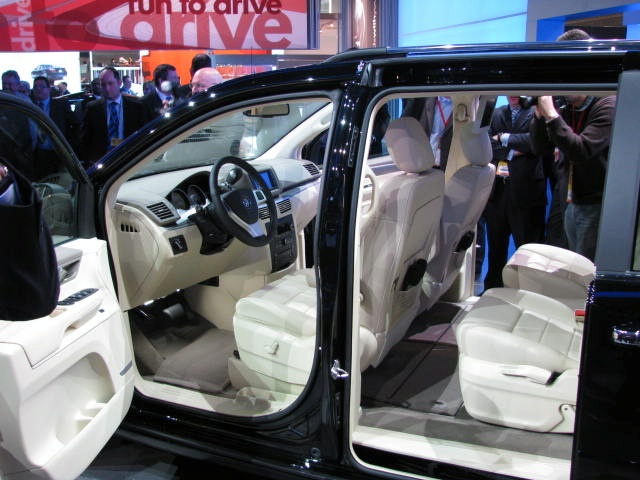 Volkswagen Routan Interior Show Up
 Volkswagen Routan Engine
 Volkswagen Routan Large and Multifunction Baggage
 Elegant Volkswagen Routan