Get Paid To Promote, Get Paid To Popup, Get Paid Display Banner -->
Showing posts with label Lexus. Show all posts

Wednesday, March 30, 2011

Lexus GS

The Lexus GS is a series of mid-size luxury sports sedans / executive cars sold by Lexus since 1993. Designed to fill the gap between the ES and LS, and to provide Lexus with a performance sedan to compete in the mid-luxury class, three generations of the GS have been produced to date. The first incarnation of the GS was introduced in 1993 in the United States, Europe and selected markets in Asia. The second generation model premiered in 1998, using a new platform and adding a V8 version for the first time outside Japan. The current third generation GS, which premiered globally for the 2006 model year, comes in both V6, V8, and hybrid versions, later known as the GS 450h performance hybrid. The third generation GS is also the first model to feature Lexus' own L-finesse styling upon its introduction.


Lexus GS Review - Kelley Blue Book

Lexus GS Beautiful Lighting

Lexus GS Modification

Styled by the famous Italdesign Giugiaro firm, and equipped with an independent, double-wishbone suspension setup, the Toyota Aristo was launched in October 1991, offering two inline-6 powered versions for the Japanese market: the 3.0Q and 3.0V. The Aristo 3.0Q (codename JZS147) featured a 2JZ-GE engine which produced 226 hp (169 kW), while the Aristo 3.0V (JZS147) was equipped with a 24-valve twin-turbo 2JZ-GTE engine which produced 276 hp (205 kW). This twin-turbo engine was the same as could be found in the Toyota Supra RZ (JZA80). In 1992, a third model, the V8-powered 4.0Zi-Four (codename UZS143), joined the Aristo lineup. This model came with standard four-wheel drive and a 250 hp (186 kW) 1UZ-FE engine. This V8 had also been used in the first generation Lexus LS and the Toyota Crown Majesta. However, the only engine available for export markets was the 2JZ-GE inline-6.

Lexus GS Interior

Lexus GS Engine

Lexus GS With High Technology

The GS interior was available with leather bird's-eye maple or walnut trim. Major standard features ranged from a 10-way driver and front passenger power and heated seats with three-position Lexus Memory System, SmartAccess keyless system with push-button start, a driver-side hidden drop-down panel for infrequently used controls, standard 7-inch touchscreen display, and LED lighting in the cabin. Unique to the Lexus GS series was a three-pod instrument cluster with machined aluminum facings and an electrochromic feature. Optional features ranged from a power moonroof to a discrete 5.1 surround sound 14-speaker 330 watt Mark Levinson premium sound system, XM-satellite radio and DVD-based navigation with backup camera and Bluetooth technology. Competitors to the Lexus GS included the BMW 5-Series, Mercedes-Benz E-Class, Volvo S80, Audi A6, Jaguar XF, Infiniti M, and Acura RL.

Tuesday, March 22, 2011

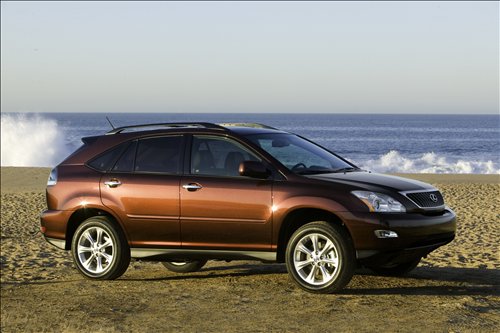
Lexus RX 350

The Lexus RX is a luxury crossover SUV sold by Lexus since 1998. The RX series has comprised multiple V6 and hybrid-powered models (such as the RX 300, RX 330, RX 350, RX 400h, and RX 450h), in either front-wheel drive or all-wheel drive versions. Three generations of the Lexus RX have been produced to date, in compact or mid-size form. The Lexus RX has been the best-selling luxury SUV on the US market since its introduction and has ranked as among the best-selling luxury vehicles in the United States. The RX is the only Lexus vehicle to be produced within as well as outside Japan, with North American market RX 350s being made at the Cambridge plant in Canada.

Elegant Lexus RX 350

Exotic Lexus RX 350

The Lexus RX first premiered in 1997 as a Lexus concept, followed by the debut of the production RX 300 model at the 1998 North American International Auto Show. In 2003, the second generation RX debuted in the U.S., and the redesigned RX 330 went on sale shortly after. Equivalent versions of the first and second generation models were sold in Japan under the Toyota Harrier nameplate until 2008. In 2006, the RX line added the world's first luxury hybrid, the RX 400h. The redesigned third generation RX 350 went on sale in early 2009, followed later that year by the second generation Lexus RX hybrid, the RX 450h.

Lexus RX 350 Interior

Black Lexus RX 350

Lexus RX 350 Inside

The redesigned RX 350 features a revised 3.5-liter 2GR-FE V6 engine producing 275 horsepower (205 kW) with a wider power curve, it remains ULEV-II certified and now uses a six-speed automatic transmission with sequential shift. A double wishbone rear suspension setup replaces the previous MacPherson strut design for improved handling and greater cargo space, while an optional Sports Package adds a performance-tuned suspension. Both non-hybrid and hybrid models continue in either front or all-wheel drive configurations, with the all-wheel drive system gaining Active Torque Control for greater efficiency, and all models are built off the new midsize flexible K-platform. American RX 350 sales began in February 2009 as a 2010 model.

Friday, March 18, 2011

Lexus IS250C, 2010

Lexus IS250C, 2010


The new Lexus IS250C.
The new model combines the award-winning design of the IS sports saloon with outstanding open-top engineering ingenuity.
The IS250C displays Lexus quality and attention to detail in every aspect of its construction and is designed to exceed customer expectations with its fusion of top-down driving pleasure and uncompromised dynamic performance.
It also boasts the fastest opening time for a three-part roof design, with its lightweight aluminium structure folding away in just 20 seconds.

The EXTERIOR DESIGN
The Lexus IS250C builds on the elegant proportions, sweeping, sculptural lines and contrasting convex and concave surfacing of the IS saloon range to combine the muscular appeal of a sports coupe with the stylish lines of a convertible.
Only the bonnet, headlamps, door handles and mirrors are shared with the IS saloon, all other body panels have been redesigned to ensure they harmonise perfectly with the three-part folding roof.

The INTERIOR DESIGN AND COMFORT
The Lexus IS250C offers the same high levels of luxury and practical innovation as the IS saloon, with a number of bespoke technical revisions designed to ensure the on-board comfort and entertainment systems operate effectively when the roof is down.
The instrument panel, surrounding elements and the steering wheel are the same as on the IS saloon, but the instrument binnacle in front of the driver has been extensively revised to ensure good visibility is maintained during top-down driving.
The climate control system has been configured for top-down motoring, with the addition of speed sensitive control, which automatically increases air flow when the roof is lowered and further increases it in line with vehicle speed.


The RIDE COMFORT
The Lexus IS250C uses the proven front double wishbone and multink rear suspension format from the IS saloon range to give sporting, agile performance. Significant chassis revisions promote greater ride comfort suitable for a convertible and ensure consistent dynamic performance in both coupe and convertible guise.
Extensive temperature, vibration and shaking tests were carried out to ensure the changes to the bodyshell and chassis maintain NVH characteristics almost identical to those of the IS saloon. Class-leading low wind noise levels are achieved with help from acoustic glass for the windscreen and painstaking design of the roof, door and window panel seals.

The SAFETY
The Lexus IS250C has been designed to achieve a five-star frontal impact rating in Euro NCAP crash testing, with world-class safety performance in both coupe and convertible configuration. Numerous changes in the body structure enhance collision strength, roll-over protection and torsional rigidity, minimising cowl shake and optimising chassis control.

For added protection when driving with the roof down, the Lexus IS250C is equipped with new-design larger side airbags that provide head protection in the event of a side impact. The bodyshell also features additional energy-absorbing side impact pads for both front and rear seat occupants.

Thursday, February 24, 2011

2011 Geneva Preview: Lexus LFA Nurburgring Package


Lexus just releases new photos and details for the Lexus LFA Nurburgring Package ,which will debut at the Geneva auto show next week.

The package celebrates Lexus� class victories at the 24 Hours of N�rburgring last May. Lexus isn�t actually adding to LFA production; instead, the automaker says that 50 of the 500 cars set to be built will be equipped with the package.

Available in Matte Black, Black, White or Orange, the interior can be had in Black and Red, Black and Pur�ple or all Black. Plus, all Nurburgring editions get added carbon� fiber interior bits, plus carbon racing seats.

Power is also on the up. From the standard 4.8-litre V10 with 560 PS (412 kW / 553 bhp) comes a new power figure of 570 PS (419 kW / 562 bhp) and reduced gearshift times. Performance times are also down; 0 - 62mph flashes by in 3.7 seconds and top speed is 325 km/h (202 mph).

The automated manual six-speed transmission�s shift regime has been recalibrated too, swopping gears in only 15 miliseconds, thereby enabling the LFA N�rburgring package to sprint from 0-100km/h in only 3.7 seconds.


Lexus LFA with N�rburgring PackageLexus LFA with N�rburgring PackageLexus LFA with N�rburgring PackageLexus LFA with N�rburgring PackageLexus LFA with N�rburgring PackageLexus LFA with N�rburgring PackageLexus LFA with N�rburgring PackageLexus LFA with N�rburgring PackageLexus LFA with N�rburgring PackageLexus LFA with N�rburgring PackageLexus LFA with N�rburgring PackageLexus LFA with N�rburgring PackageLexus LFA with N�rburgring PackageLexus LFA with N�rburgring PackageLexus LFA with N�rburgring PackageLexus LFA with N�rburgring PackageLexus LFA with N�rburgring PackageLexus LFA with N�rburgring PackageLexus LFA with N�rburgring PackageLexus LFA with N�rburgring PackageLexus LFA with N�rburgring PackageLexus LFA with N�rburgring Package


Press Release

LEXUS PRESENTS LFA N�RBURGRING PACKAGE

  • Lexus reveals special performance package for its LFA supercar at the Geneva motor show
  • N�rburgring Package offered as an option on a maximum of 50 cars - just 10 per cent of the total LFA production run
  • Designed for more track-focused performance through additional aerodynamic elements, lowered suspension and engine revisions
  • 10bhp increase in power from V10 engine to 562bhp ensures LFA's 0-62mph acceleration time of 3.7 seconds is maintained
  • LFA production underway since December, with one hand-crafted car completed per day
  • Use of advanced, automated Carbon Fibre Reinforced Plastic (CFRP) production processes serves as a test bed for future models

To celebrate the LFA's hat-trick of class wins at the N�rburgring 24 Hours race, Lexus has created the N�rburgring Package, an array of aerodynamic features, suspension adjustments and revisions to the 4.8-litre V10 engine that give the supercar a more track-focused profile. Shown in public for the first time at the Geneva motor show, the performance option is available on just 50 of the 500 cars that will be built. These versions will be crafted during 2012, the second full year of LFA production.

To sharpen the car's circuit driving performance even further by increasing downforce at high speed, the N�rburgring Package introduces modifications and additions to several key carbon fibre reinforced plastic (CFRP) components. These include a larger front spoiler, fin-type side spoilers, a canard fin and a fixed rear wing.

To ensure the LFA maintains its 3.7-second acceleration time from nought to 62mph, in spite of the increased drag, the V10 engine has been revised to increase maximum power by 10bhp to 562bhp. Shift times in the six-speed sequential transmission are just 0.15 seconds.

In terms of handling modifications, the package features suspension tuning and a 10mm reduction in the ride height. Exclusive mesh-type wheels are introduced, fitted with dedicated high-grip tyres.

Exterior colour choices are restricted to matte black, black, white or orange, with interiors finished in black and red, black and purple and all-black. Cars delivered in Europe will feature a carbon fibre centre console and door trims, with carbon fibre sports seats finished in Alcantara.

Customers who specify the package will also be offered one-to-one driving tuition from a N�rburgring chief instructor and a year's pass to enjoy their car on the famous Nordschleife circuit.

CFRP parts manufacturing

LFA production began in December with just one hand-crafted car completed per day. A team of 175 people are involved in CFRP parts manufacturing, vehicle assembly and painting.

CFRP is exceptionally strong, rigid and lightweight, and accounts for about 65 per cent of the LFA's body structure weight. This amounts to a saving of about 100kg, compared an equivalent all-aluminium body.

Lexus is producing and assembling the CFRP components in-house, with a view to future development of the technology. It is a time-consuming process, compared to working with steel or aluminium, but the LFA project provides a valuable test bed for new, automated processes which will be used in the manufacture of future Lexus and Toyota models.

Different manufacturing technologies are used according the shape, role and required properties of each component.

  • Pre-preg: this is an industry-standard composite sheet material made of carbon fibre, pre-impregnated with epoxy resin. It is used for the LFA's main structural elements, such as the dash, side and cross-members and panels.
  • Resin Transfer Moulding (RTM): this is dry sheet fabrication, with epoxy resin injected into the mould. It is mainly employed in the LFA's secondary main frames, such as the crash boxes, roof side rails and vehicle floor.
  • Carbon fibre - Sheet Moulding Compound (C-SMC): this is used for fabricating the upper body components and frames that have complex geometries.

Adhesive bonding

The LFA assembly line moves through five consecutive processes, each of which has been digitally validated. For the first four - sub-assembly, underbody, small aluminium parts and main body - adhesive bonding is used. Final assembly of the aluminium parts is by mechanical fastening.

This is the first time Lexus has used adhesive bonding for main body assembly, a process that has required new quality control measures to be implemented to ensure each of the five stages involved in the bonding meets the required criteria.


Sunday, February 6, 2011

Lexus GX 460, 2010

Lexus GX 460, 2010


Lexus has introduced an all-new, second-generation Lexus GX 460 luxury utility vehicle for 2010 that is more powerful, more efficient, quieter and more luxurious than the Lexus GX 470 model it replaces. The 2010 GX 460 achieves all of these significant developments while its 10 standard airbags and the available Pre-Collision System help enhance safety.

Positioned between the brand's LX 570 premium luxury utility vehicle and unibody-based Lexus RX models, the 2010 Lexus GX 460 combines "right sized" midsize packaging with family-friendly comfort and premium craftsmanship. The Lexus GX 460 has a standard seven-passenger configuration. Once again built with rugged body-on-frame construction, the 2010 Lexus GX 460 is also equipped with full-time four-wheel drive and the advanced Kinetic Dynamic Suspension System (KDSS) to help provide both exceptional on-road ride and handling and true off-road capability.

The 2010 Lexus GX 460 is powered by an all-new 4.6-liter V8 that is both more powerful and more efficient than the 4.7-liter V8 it replaces. The new engine produces 301 horsepower and 329 lb.-ft. of peak torque, and is teamed to a new six-speed automatic transmission with sequential shift. Combined city/highway fuel economy is improved by 13 percent to an EPA-estimated 17 mpg (vs. 15 mpg in the 2009 GX 470) -- better than other V8 luxury utility vehicles and competitive with some six-cylinder models. The Lexus GX 460 has an EPA-estimated 15 mpg city and 20 mpg highway.

With the same vehicle footprint as the Lexus GX 470 it replaces, the 2010 GX 460 provides a more versatile interior. The second row seat slides 4.1 inches fore/aft to maximize passenger and cargo carrying ability. The foldable and reclining second row seats also feature a 60/40 walk-in function to access the standard power fold-flat third row seats. The rear door window uses a flip-up glass panel for added convenience.

Luxury is enhanced in the 2010 Lexus GX 460 by an even quieter cabin, as well as new additional standard features and options. The 2010 Lexus GX 460 features standard heated and ventilated front seats for example. Among the new luxury options are semi-aniline leather, a heated steering wheel, and heated outer second-row seats. New multimedia features - both standard and optional - expand onboard family entertainment choices.

Engine/Transmission/Drivetrain/Performance
The 2010 Lexus GX 460 takes its model designation from an all-new 4.6-liter V8 engine. The new 32-valve DOHC engine features aluminum alloy cylinder heads and block with dual Variable Valve Timing with Intelligence (VVT-i), which controls valve timing and overlap on both the intake and exhaust camshafts to optimize power, fuel efficiency and emissions. (The previous 4.7 had VVT only on the intake camshafts.) Peak torque is also up for the new 4.6, now 329 lb.-ft. at 3,500 rpm vs. 323 lb.-ft. at 3,400 rpm for the 4.7-liter engine.

The new 4.6-liter V8 is teamed to a six-speed electronically controlled automatic transmission, compared to a five-speed automatic with the previous 4.7-liter, benefiting both performance and fuel economy. The new transmission fits in the same space as the previous five-speed and features a higher top gear ratio. The new powertrain helps make the 2010 Lexus GX 460 feel more responsive in everyday driving and quieter than the previous model. The 2010 Lexus GX 460 retains the same 6,500-lb. towing capacity as the GX 470 offered.

The Lexus GX 460 comes equipped with standard full-time four-wheel drive using an electronically controlled transfer case and a TORSEN� torque-sensing center differential. It also offers a low range for off-road driving. The TORSEN differential distributes power 40:60 under most driving conditions and changes the ratio as needed based on steering input and wheel slip.

The ability to change to a 30:70 ratio during steering maneuvers helps enhance vehicle tracking through curves. If the rear wheels spin, the center differential can change the ratio to 50:50 to help control the slippage. The TORSEN differential also helps make the Lexus GX 460 less prone to slippage caused by sudden changes in road-surface conditions, such as driving through a puddle or over an ice patch. The rear differential has also been strengthened for 2010.

Chassis/Body/Suspension/Tires/Brakes
The 2010 Lexus GX 460 is one of the few premium brand luxury utility vehicles that can deliver genuine trail driving capability. Combining that capability with Lexus luxury and on-road performance makes it even more exceptional. Lexus studied vehicle usage of current owners and found that many use their GX models for family hauling during the week and vacations and camping trips on weekends. They often tow a boat or watercraft and sometimes drive to areas with unpaved and rugged trails.

Like the previous GX 470, the 2010 GX 460 has robust body-on-frame construction and does not compromise on- or off-road performance; the high-strength chassis and dynamic suspension control technology support both.

The power rack-and-pinion steering system helps make it easier to maneuver the Lexus GX 460 in tight spaces. Rear Adjustable Height Control (AHC) enhances the vehicle's flexibility in a wide range of driving situations.

Kinetic Dynamic Suspension System (KDSS)
KDSS is standard on the Lexus GX 460, and enhanced for 2010 with steering and yaw sensors. By adjusting roll resistance provided by the front and rear stabilizer bars, KDSS can reduce maximum body-roll angle by as much as 50 percent to help enhance both on-road handling response and off-highway capability.

Using hydraulic cylinders acting on each stabilizer bar and linked by a pressure-sensing valve, KDSS reduces the degree of roll stiffness provided by the stabilizer bars in response to changing road conditions and driver inputs. Because KDSS allows the stabilizer bars to disengage in certain situations like off-road driving, the nominal stiffness of the bars can be notably increased to help reduce body-tilt and improve on-road handling.

During on-road cornering, when both front and rear cylinders are compressed, no fluid flows in the system and the stabilizer bars work conventionally to help reduce body lean. In off-road driving situations, KDSS allows the wheels on each axle to move with a larger degree of side-to-side independence, helping to minimize any tendency for wheel lift. When the Lexus GX 460 encounters an uneven surface, one compressed cylinder causes fluid to flow between the front and rear cylinders, allowing the stabilizer bars to move freely. That action increases wheel travel and articulation and helps to equalize wheel loading.