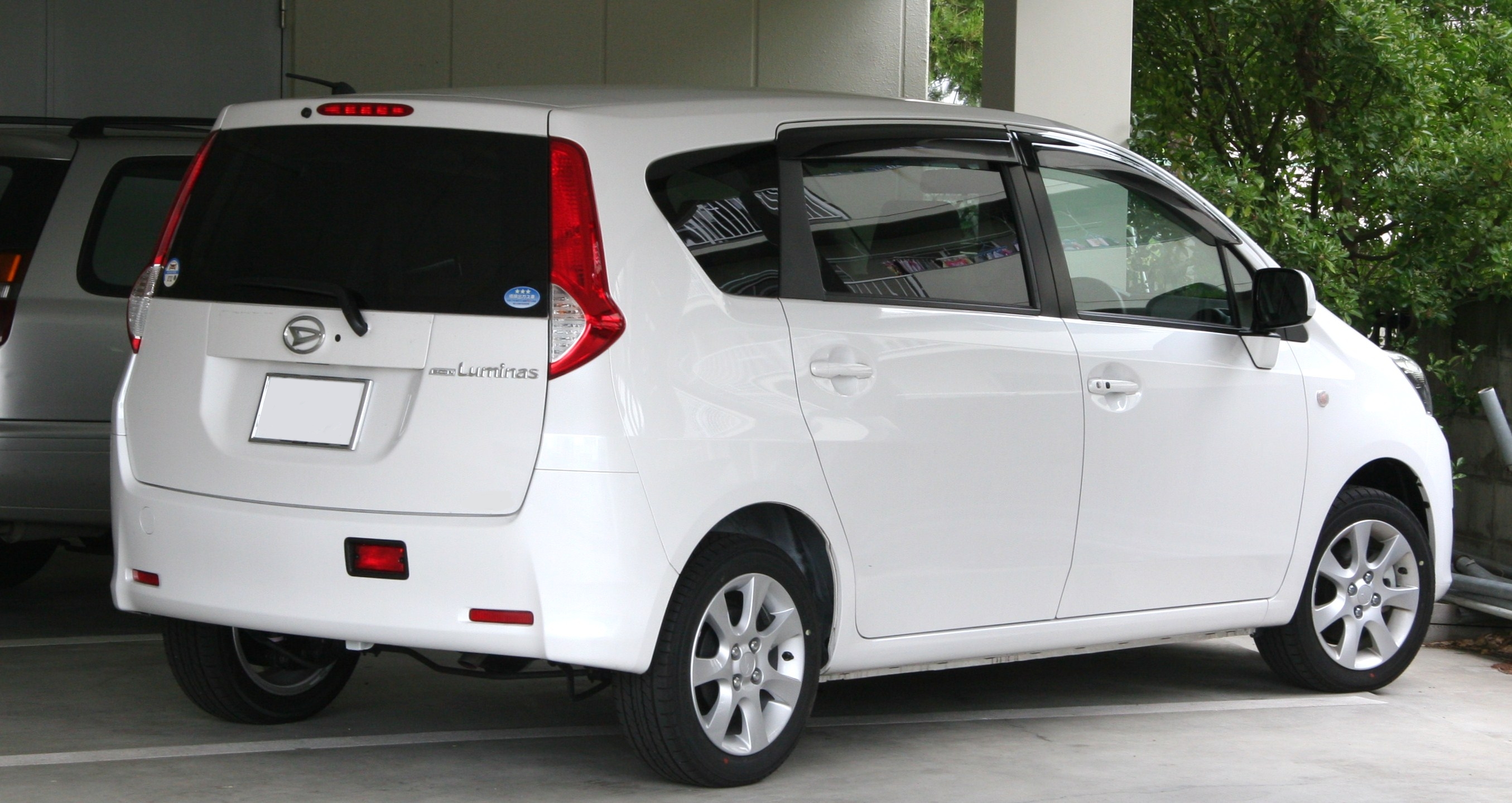
Daihatsu Materia Design Concept, 2008


The Materia's funky yet practical shape maximises interior space and was designed to be both distinctive and spirited. It is sold as both a Toyota and Daihatsu in Japan.
Its exceptionally short overhangs and flared wheelarches give a ground-hugging stance, while the squared-off passenger compartment promises - and delivers - outstanding space.
The front design is quite imposing with a chunky, deep bonnet and chiselled look to the headlamps and narrow but wide grille, cut into the deep bumper.
The Materia's rear also emphasises its width, strength and stability, emphasised by a swooping, low-mounted panel that connects the narrow rear lamps which gently curve over each rear wheelarch.
From the side, large 15 ins diameter spoked alloy wheels - linked by deep side skirts - further reinforce the message of stability. The generous 185/55 tyres combined with a wide track 'fill' the wheel openings.
Size Comparisons
The Daihatsu Materia's spacious cabin features both a generous interior width and length clothed in a compact body with excellent manoeuvrability thanks to good visibility and a tight 9.8 metre turning circle (kerb-to-kerb).
Its overall length of 3,800 mm is between the Renault Modus (3,792 mm) and Vauxhall Meriva (4,042 mm). The Daihatsu's width of 1,690 mm is almost identical to the 1,695 mm of the Renault and 1,694 mm of the Vauxhall.
The Materia's 1,635 mm height compares with the1,589 mm of the Modus and 1,624 mm of the Meriva, while the Daihatsu's wheelbase of 2,540 mm exceeds the 2,482 mm of the Renault but is slightly shorter than the Vauxhall's 2,630 mm.
Its 1,420 mm interior width far exceeds the Renault Modus which can only offer 1,280 mm. This, combined with an interior length of 1,950 mm (Vauxhall Meriva 1,825 mm) offers outstanding useable space.
Versatile, Funky-Looking Interior
The Materia's stylish and versatile interior includes a rear seat that has a rake-adjustable backrest which can also be fully reclined to form a bed, joining the equally fully-reclining front seats.
The rear seat also features a 60/40 split plus fore and aft slide adjustment of 160 mm. This allows a fully-flexible rear legroom/load space compromise. The rear tailgate opening is flush with the load floor for easy loading and unloading.
A compartment under the rear floor allows the storage of various items such as tools, while a deep bottle holder is also included in the side of the luggage compartment. Interior bottle holders can be found in both front and rear doors plus four in the centre console.
Meanwhile, the interior design itself is both funky and interesting with, for example, blue illumination of the front door armrests and circular front door speakers.
The centrally-mounted acrylic instrument panel creates a futuristic, three-dimensional look boosted by a swooping, stadium-shaped arc to the entire fascia.
Other distinctive features include a glossy black finish to the flush-fitting audio unit and side air-conditioning vents for a high-quality look.
Lively, Frugal, Advanced Petrol Engine
The new Daihatsu Materia features a lively and frugal 1.5 litre petrol engine offered with the choice of either five-speed manual of four-speed automatic transmission.
The engine itself is highly advanced and is similar to that fitted to the Daihatsu Terios compact SUV and can also be seen in 1.3 litre form in the Sirion supermini.
Featuring Dynamic Variable Valve Timing (DVVT) which enhances low-speed pulling power and high-rev response, the twin overhead camshaft unit is compact and light, with an alloy head and block.
Power is 103.3 PS at 6,000 rpm with torque of either 97.4 lb ft at 4,400 rpm for the Daihatsu Materia manual or 101.8 lb ft in the automatic. The engine has a 10.0:1 compression ratio and features a bore and stroke of 72 x 91.8 mm.
The five-speed manual gearbox and four-speed automatic both have carefully chosen ratios that provide sprightly acceleration from standstill yet relaxed cruising.
To further aid refinement, various sound-insulation measures enhance noise-suppression. These include asphalt sheets for the passenger floor plus fascia, engine compartment and body frame insulators. All four doors have double seals for a quality closing experience and further refinement boost.
World's First Self-Regenerating Catalyst
The new Sirion 1.3 litre launched in 2005 featured the world's first self-regenerating catalyst. This innovation is also standard on the new Copen 1.3 and now the new 1.5 litre Daihatsu Materia.
It effectively extends the life of the catalytic converter, reducing maintenance costs and is kinder to the environment as it keeps the catalyst 'healthier' over a higher mileage meaning the already low 169 g/km does not increase as the engine becomes older.
The revolutionary technology works by providing a self-regenerating capability in the particles of the precious metal which normally degrades.
European-Tuned Chassis
Daihatsu has tuned the Materia's chassis for European markets and the result is a firmly-damped but smooth ride and excellent control of body roll despite the car's higher-than average stance.
The power-steering is well-weighted, with good straight-line stability and reassuring self-centring. Meanwhile, the front and rear anti-roll bars coupled with generous low-profile tyres keep understeer well in check.
The semi-independent rear features a conventional torsion beam and coil springs with separate shock absorbers. The anti-roll bar is complemented by a curved shape to the torsion beam which further improves roll stiffness.
The Daihatsu Materia has a conventional hydraulic power-assisted rack-and-pinion steering system as opposed to the growing trend towards electric power-assistance. The benefits are greater feel and sensitivity.
High Safety Levels Safety is given high priority in the Daihatsu Materia, especially considering its likely roll as a family car. It therefore has all the latest life-saving and injury-reducing initiatives.
For example, both front seats have seatbelt pretensioners and force limiters. These are designed to provide just the right amount of restraint for the level of retardation.
Should parents wish to carry their offspring in a child seat placed on the front passenger seat, a switch can be used to disable the passenger airbag.
Twin front airbags and side airbags are also standard as are dual side-impact door beams. The body structure is designed to absorb all-angle impacts while maintaining survival space around the occupants.
Various materials are used around the cabin to minimise impact injury such as to the knees and lower legs, while the brake pedal features a special mechanism which reduces intrusion into the cabin.
The braking system features servo-assisted front ventilated disc brakes and rear drums. Anti-lock (ABS) is also standard as is Electronic Brakeforce Distribution (EBD) which further avoids the locking-up of individual wheels during severe braking.


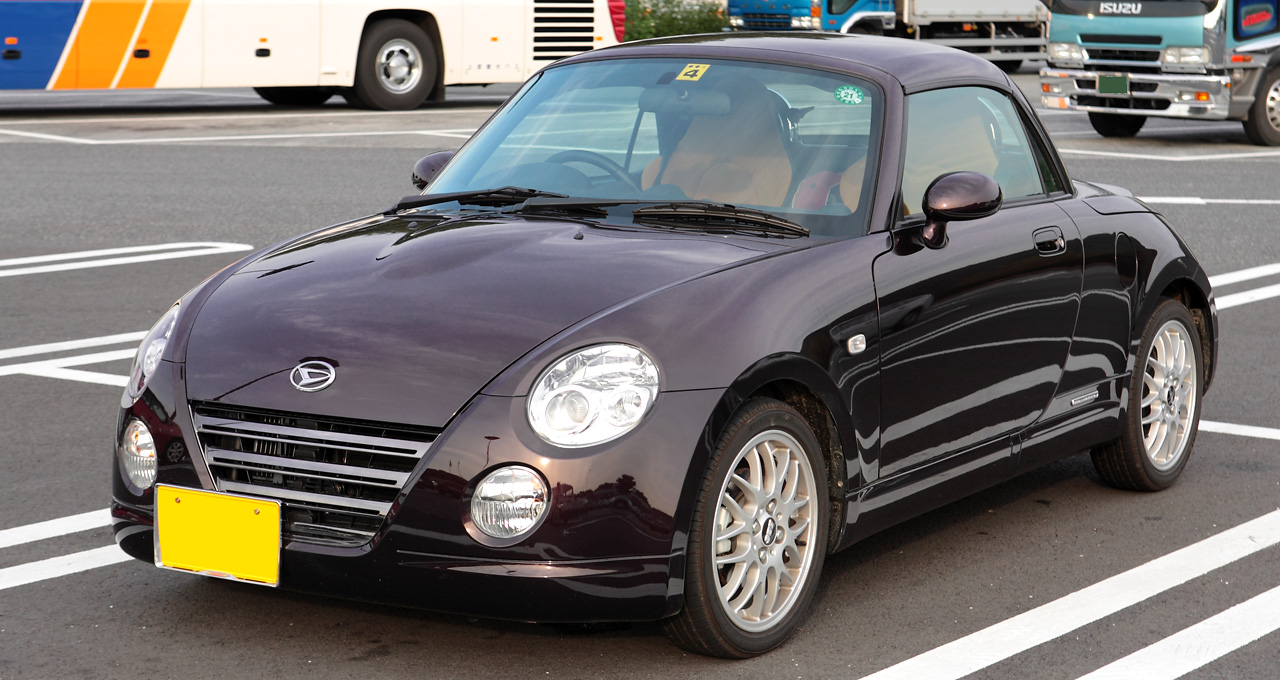 The Daihatsu Copen is a 2-door roadster with an aluminium retractable hardtop built by the Japanese car company Daihatsu. It first debuted at the 1999 Tokyo Motor Show, as the Daihatsu Copen concept. In two years, the OFC-1 was also completed as a precursor to the Copen, based on Daihatsu's front-wheel-drive light-car platform. The Copen was originally designed with a 660 cc turbocharged engine in order to meet Japanese kei car regulations. However, it no longer meets environmental emissions standards in several other countries, and so in these markets the Copen is fitted with a more powerful 1.3 L engine. At the 2005 Frankfurt Motor Show, Daihatsu revealed two new trim levels of the Copen, the 1.3l and the 'ZZ'. On January 13th 2011, Daihatsu announced that it would withdraw the Copen from the European market effective from 31st January 2013 due to the ongoing strength of the Japanese Yen.
 Yellow Daihatsu Copen
 Elegant Daihatsu Copen
 Daihatsu Copen With High Technology
 Daihatsu Copen Interior
 Red Daihatsu Copen On The Road
 Daihatsu Copen Hatchback