Get Paid To Promote, Get Paid To Popup, Get Paid Display Banner -->
Showing posts with label peugeot. Show all posts

Saturday, April 16, 2011

Peugeot 207

The Peugeot 207 is a supermini produced by the French automaker Peugeot and unveiled in January 2006. According to JATO Dynamics, an automative market researcher, the model was the bestselling car in Europe in 2007. The 207 was launched in France, Spain and Italy during April 2006 and later on in other European, Israeli and Arabic markets. The UK launch was on 8 June 2006. Amicus and the TGWU, both unions representing workers at PSA's UK manufacturing plant in Ryton, Coventry, chose the same day to launch a campaign calling for the boycott of PSA's Peugeot and Citroën vehicles in the UK. The campaign was in protest against the company's plans to close the Ryton plant. Despite the boycott the sales of Peugeot in UK grew. Not to be confused with the 207 in the Brazilian market. That model is essentially a 206+ sold in some European markets. The 207 is the successor to the 206. The 207 is based on a modified version of the platform used for the Citroën C3, and is built in Poissy and a new plant near Trnava, Slovakia. Initially three petrol engines were available: 1.4-litre 8v with 75 or 16v 90 hp (67 kW) and 1.6-litre 16v with 110 bhp (82 kW; 112 PS). From late 2006, the 1.4 & 1.6 16v models were replaced by the new 1.4 vti 95 bhp (71 kW; 96 PS) and 1.6 vti a 120 bhp (89 kW; 122 PS) Valvetronic engines. Two turbocharged versions, one with 150 bhp (112 kW; 152 PS) , and the other with 175 bhp (130 kW; 177 PS) were also added to the range. The latter four engines result from the cooperation agreement between PSA and the BMW group. The diesel-powered engines available are a 1.4 litre 70 hp (52 kW) or a 1.6 litre HDi with maximum output of 90 or 110 hp (82 kW), the latter with the addition of an intercooler. The 207 is available as a three- or five-door hatchback, a 207 SW Station Wagon and a 207 CC coupé convertible. A GTI version is available with the 175 hp (130 kW) turbocharged 1.6 litre engine. It has sold well in Britain, being the sixth best selling car overall (and third in the supermini sector) in 2007 with more than 67,000 examples being sold.


Top Gear - Peugeot 207 vs Parkour (Free-Runners) - BBC
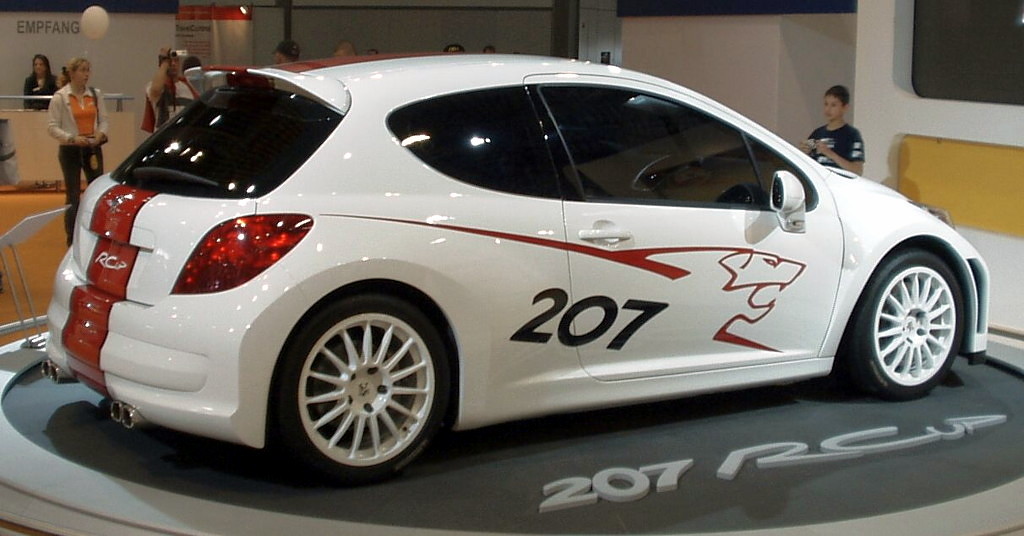
The Peugeot 207 Epure was a concept car presented at the Mondial de l'Automobile 2006 designed to preview the 207 CC coupé cabriolet which followed. The 207 Epure was fitted with a sophisticated hydrogen fuel cell.At the 2006 Geneva Motor Show Peugeot also unveiled a sporty concept car based on the 207 and badged as the 207 RCup. This Super 2000 version is powered by a 2.0-litre petrol engine with maximum output of 280 hp (209 kW) and is intended as a successor for the 206 World Rally Car which was successfully used by Peugeot in the World Rally Championship, where it helped the team winning the manufacturers' championship in 2000, 2001 and 2002.A Super 2000 version of the 207 is used in the Super 2000 World Rally Championship as well as several rally championships across Europe. The 2008 European Rally drivers' champion and the 2007 and 2008 Intercontinental Rally Challenge drivers' champions drove 207 Super 2000s.The Peugeot 207 was facelifted in July 2009. The car has been given a new front end and LED lights on the rear giving the car a bigger look.

Silver Peugeot 207 On The Road

Peugeot 207 Interior View

Cool Peugeot 207 In Glossy Orange Color

Peugeot 207 Parking

Sporty Peugeot 207

Friday, March 25, 2011

2011 Peugeot 206


PEUGEOT + 206 2011

Blue 2011 Peugeot 206

Luxury 2011 Peugeot 206

Impressive 2011 Peugeot 206

2011 Peugeot 206 Interior

2011 Peugeot 206 Parking

2011 Peugeot 206 Modification

Red 2011 Peugeot 206 With Super Mini Design

Thursday, March 3, 2011

2011 Peugeot RCZ


Exotic White 2011 Peugeot RCZ


Elegant 2011 Peugeot RCZ


2011 Peugeot RCZ Elegant Interior


2011 Peugeot RCZ Concept


Sporty 2011 Peugeot RCZ For Racing


2011 Peugeot RCZ Hatchback


2011 Peugeot RCZ Interior View


2011 Peugeot RCZ Cool Wheels


2011 Peugeot RCZ Rare Side View

Tuesday, February 22, 2011

Peugeot RD Concept, 2009

Peugeot RD Concept, 2009


The main innovative operating feature of the Peugeot RD Concept car is its ingenious system of articulation that provides irreproachable road holding allied with the ability the easily thread its way through urban traffic.

Equipped with an environmentally friendly electric motor, the driving position in this single-seat concept offers a new feeling of freedom, thanks to its panoramic vision, voice-message driving assistance and a heads-up display system that gives all the information required for travelling in complete safety.

The concept car combines the sensations of a 3-wheeled scooter with the driving pleasure of a saloon car, while retaining all the essential functions of both modes of transport... and while adding a silent environment.

Peugeot RC Concept, 2008

Peugeot RC Concept, 2008


Peugeot RC Concept, 2008

Peugeot Flux Concept, 2007

Peugeot Flux Concept, 2007


The concept car Flux, designed by Mihai Panaitescu, won the 4th Peugeot design competition. The car was designed to achieve universal pleasure by adapting different lifestyle situations. The theme of this fourth competition, summed up by acronym P.L.E.A.S.E. Innovate!, has inspired creativity of web based designers throughout world, resulting in more than 4,000 projects.

Complimenting present automotive aspirations, Flux has shown the theme�s most relevant illustrations, since its concept corresponds to a type of car that achieves utter driving Pleasure through its Light weight and Efficiency, while at the same time remaining Accessible through the Simplicity and Ecology of its design.

The Flux was chosen by a jury chaired by Fr�d�ric Saint-Geours, General Manager of Automobiles Peugeot and made up of Peugeot representatives, its Style Centre, Xbox, but also of web based people who voted online.

Unveiled at this year�s Geneva show, and thanks to its sophisticated design, Flux will be making a second appearance at the Frankfurt Motor Show. Flux will appear �real� in the form of a full-scale model presented at Peugeot�s exhibition space and �virtual� in a new version of the PGR 4 game on Xbox 360. These two elements constitute the two most fantastic prizes of the 4th Peugeot design competition.

The 4th design competition attracted greater participation, with more than 200 additional projects compared with the 3rd competition (4,029 compared with 3,800), confirming its international appeal, with 113 countries represented as opposed to 107 in the last competition.

Monday, February 7, 2011

2011 Peugeot 308 Facelift


Peugeot has just released the images and details of the revised 308 hatchback. which will make its first appearance at the Geneva motor show in March.

The new�Peugeot 308 will be available as Hatchback, CC and SW and comes in Access, SR, Active and Allure trim levels. There�ll also be a new Eco model � the Peugeot 308 e-HDi microhybrid diesel. The USP of the e-HDi is its CO2 emissions which dip to 98g/km, meaning free VED and congestion charge.

LED driving lights are the other big difference seen on�the nose, and overall changes to the front bumper mean an amazing 25kg average weight saving. The new front end will grace the 308 hatch, SW estate and CC coup�-cabriolet, but at the back, each variant stays�the same. The revamped range also gets a new model: the e-HDi microhybrid diesel.�

The Peugeot 308 range is divided into 8 engines: the 1.4 petrol 98 hp 4.1 VTI, 1.6 VTI 120 hp, 156 hp and 200 hp diesel and 92 hp 1.6 HDI, 2.0 HDI 112 hp and 150 hp and 163 with manual transmission or 5 6-speed automatic and on some setups.

The new Peugeot 308 will be available in three body styles; Hatchback, CC and SW, and four multi-model trim levels; Access, SR, Active and Allure. A range topping hatchback and CC THP 200 model will also be available in a single GT trim level.

The interior has been updated with new combinations of materials and accessories of the features included, among which confirmed the GTi, characterized by red stitching, GTi logo on the steering wheel and aluminum alloy in Storm Gray color.


Peugeot 308 FaceliftPeugeot 308 FaceliftPeugeot 308 FaceliftPeugeot 308 FaceliftPeugeot 308 FaceliftPeugeot 308 FaceliftPeugeot 308 FaceliftPeugeot 308 FaceliftPeugeot 308 FaceliftPeugeot 308 FaceliftPeugeot 308 FaceliftPeugeot 308 FaceliftPeugeot 308 FaceliftPeugeot 308 FaceliftPeugeot 308 FaceliftPeugeot 308 FaceliftPeugeot 308 FaceliftPeugeot 308 FaceliftPeugeot 308 FaceliftPeugeot 308 FaceliftPeugeot 308 FaceliftPeugeot 308 FaceliftPeugeot 308 FaceliftPeugeot 308 Facelift


Press Release

NEW PEUGEOT 308 � ELEGANT, EFFICIENT AND FULL OF NEW TECHNOLOGY


  • New micro-hybrid e-HDi reduces CO2 emissions to 98 g/km*
  • Latest generation Euro 5 VTi, THP petrol and HDi diesel engines
  • Four model range � Access, SR, Active and Allure � all with high-level specification
  • Two range topping GT THP 200 models � Hatchback & CC
  • Range starts at �15,245 O.T.R
  • On sale in May
The New Peugeot 308 will be launched in the UK in May with a new look, a range of innovative technology and CO2 emissions from just 98 g/km.

Since launch in September 2007 over 900,000 308 models have been sold worldwide. In the UK over 84,000 vehicles have been sold, making it the second most popular Peugeot model.
The New Peugeot 308 is being launched onto the UK market integrating all the latest Peugeot styling elements already seen on the Peugeot 508 and the SR1 Concept Car. The new Peugeot 308 will be available in three body styles; Hatchback, CC and SW, and four multi-model trim levels; Access, SR, Active and Allure. A range topping hatchback and CC THP 200 model will also be available in a single GT trim level.

A new look at the front with the latest LED headlamps and running lights gives the New Peugeot 308 an elegant and modern look. All the dynamic and emotional strengths of the original Peugeot 308 have been retained and strengthened further with the introduction of more efficient engines and Peugeot�s innovative micro-hybrid
e-HDi Stop & Start technology.

Peugeot�s micro-hybrid e-HDi Stop & Start technology is the latest generation technology and combined with Peugeot�s class leading 1.6 litre HDi FAP 112 Euro 5 diesel engine reduces CO2emissions to 98 g/km. This engine option will also be available with either a six-speed manual gearbox or a six-speed electronically controlled manual gearbox (EGC). This will give the New Peugeot 308 the lowest emissions in its segment.

All models feature air conditioning, ESP (Electronic Stability Programme), ABS, EBFD, EBA, front and rear electric windows with child security, remote control central door locking with deadlocks and six SMART safety airbags.

To ensure the New Peugeot 308 is as environmentally efficient as possible all factors affecting CO2emissions have been optimised;

  • Overall weight reduced by 25 kg on average on all models
  • Fitment of new 16� ultra low rolling resistance tyres
  • Optimisation of all engine options (VTi, THP petrol and HDi diesel engines to Euro5)
  • Cx of 0.28 for the low consumption models � Record for this segment
This also enables the New Peugeot 308 HDi FAP 92 model, fitted with a five-speed manual gearbox, to emit CO2 emissions of only 110 g/km.

At launch four petrol and four diesel engines will be available.

Euro 5 Petrol Engines
1.4 litre VTi 98 �5-Speed Manual Gearbox

1.6 litre VTi 120 �5-Speed Manual Gearbox
�Automatic Gearbox

1.6 litre THP 156 �6-Speed Manual Gearbox
�Automatic Gearbox

1.6 litre THP 200 (GT Hatchback & CC models only) �6-Speed Manual Gearbox

Euro 5 HDi Diesel Engines �

1.6 litre HDi FAP 92 �5-Speed Manual Gearbox

1.6 litre e-HDi FAP 112 �6-Speed Manual Gearbox
�6-Speed Electronically Controlled Manual Gearbox

2.0 litre HDi FAP 150 �6-Speed Manual Gearbox

2.0 litre HDi FAP 163 �6-Speed Manual Gearbox (CC)
�Automatic Gearbox

The New Peugeot 308 will be launched at the 2011 Geneva Motor Show and go on sale in the UK in May. The new range will start from �15,245 on-the-road with an improved standard specification to the current model.

*The 98 g/km CO2 308 1.6 litre e-HDi FAP 112 model will be class leading in its segment and is pending approval, and will be available from summer 2011

Technologically efficient and elegant

The new Peugeot 308 comes with a new look, features innovative e-HDi micro-hybrid technology and optimises fuel consumption and CO2 emissions, which start from just 98 g/km.

With its new lines, the Peugeot 308 subtly incorporates the Marque�s latest stylistic codes. The car�s body follows the contours of the mechanical assembly underneath. The appeal of the three body shapes (Saloon, CC and SW) thus acquires a more technological elegance, illustrated by the presence of LED front lights with light guide. Dynamism and emotion are present as ever in the genes of the 308, particularly with its more assertive look thanks to new Xenon headlamps with titanium coloured mask and the hatchback in its exclusive GTi finish.

Determined to consolidate its leadership in terms of road holding and driving pleasure, the Peugeot 308 seeks to become a reference in terms of environmental efficiency. Indeed, following in the footsteps of the 508, the new Peugeot 308 features innovative e-HDi micro-hybrid technology, the latest generation STOP & START, on the 1.6 litre HDi FAP 112 bhp Euro 5 engine. This offer, on the �entry level� engine, is available with a semi-automatic manual gearbox and, for the first time, with a full manual gearbox, for optimal driveability.

In addition to micro-hybrid technology, all factors impacting the level of CO2 emissions have been optimised:

  • weight reduced by 25 kg on average per car;
  • launch of 16� tyres with Very Low Rolling Resistance;
  • optimisation of the latest generation engines (VTi, THP, HDi Euro 5);
  • Cx of 0.28 for versions with a low fuel consumption � A record in the segment.

Fuel consumption sets the standard:

  • 98 g/km of CO2* for the 308 saloon 1.6 litre e-HDi
FAP 112 bhp BMP6 � A record in the segment
(* pending approval, available in the summer of 2011
  • 104 g/km CO2 at launch);
  • available power trains, comprising 4 petrol engines ranging from 98 bhp to 200 bhp for the exclusive GTi version and 4 diesel engines from 92 bhp to 163 bhp, have also been optimised to ensure a comprehensive range of engines guaranteeing environmental efficiency. As a result, the basic version � the 308
saloon 1.6 litre HDi FAP 92 bhp with manual gearbox � is well positioned, with CO2 emissions reduced to only 110 g/km.
The dimensions and quality of equipment on the new 308 remain unchanged, regardless of body shape, guaranteeing a spacious and comfortable passenger compartment. The same is true of primary, secondary and tertiary safety, which remain at the highest level. The 308 facelift will receive its world premiere at the 2011 Geneva Motor Show and will go on sale from April 2011 in Europe. Its mission is to continue the success story of the 308 family, with nearly 900,000 models sold since its launch in September 2007.

ELEGANT LINES ENHANCED BY ADVANCED TECHNOLOGY

The design of the 308 facelift subtly incorporates the new stylistic codes of the Peugeot Marque. While the dimensions are unchanged, the new lines marry as closely as possible the car�s mechanical assembly to accentuate its athletic poise, while the front aspect gives a fresh look to the �floating� front grille concept. Greater importance accorded to unbroken surfaces marks a determination to present an elegant and luxurious style. The central protective capping, available in a black lacquer finish, has been made thinner to give greater prominence to the sheer metal. This is also true of the single air intake which is now smaller in size. Styling elements enhance the natural elegance which emanates from the 308 facelift. A satin chrome bead enhances the new front grille, as do horizontal bars, available in lustrous black or chrome according to body shape (saloon, CC or SW).

The bottom section of the lower front panel, which helps visually to broaden the car and �plant� it on the road, incorporates new dual-function lights (daytime and sidelights) shaped like a boomerang, available according to versions. With their meticulous finish, they blend perfectly and are harmoniously positioned on the upper surround of the fog light housing. Composed of variable intensity LEDs and a light guide, they guarantee a unique visual signature by day and by night while illustrating the high level of technology featured on the 308 facelift.

In the upper section, the V-shaped nose of the bonnet is one of the main expressive features of the 308. It has been redesigned to fit the car�s mechanical assembly as closely as possible and provides a new link with the floating front grille, in line with Peugeot�s new stylistic codes. The Marque badge, in its new dual material construction, is proudly positioned at the tip of the bonnet on a new black lacquer base set with a chrome bead, also in the shape of a V.

The outline of this nose, fluid and characteristic, is more curvaceous, particularly at the junction of the lights and the bonnet. The new smooth glass front headlamps, closely fitting the three cylinders, suggest a look that is both refined and assertive. And when the 308 is equipped with dynamic bi-directional Xenon headlamps complete with titanium coloured base, this look becomes even more profound, displaying all the strength of character of the 308 facelift.

The dynamism of the front aspect is echoed on the sides of the car. A styling line, running from the front wheel arches, crosses the side of the body and the rear lights before dropping towards the lower rear panel and coming to an end in the lower section.

The fluidity of the style is enhanced by the lateral glazed surface which follows a plunging waistline, and also by the panoramic rear window, which overlaps the rear quarter panel pillars.

Lastly, to establish the general appearance of the 308, a lower waistline starting from the lower front panel extends as far as the rear bumper. The car therefore seems well poised on the road, ready to exploit its dynamic qualities to the full . New diamant� effect 16 or 17 inch alloy wheels or Storm Grey 18 inch wheels for the GTi version underline this dynamic appeal.

The sense of dynamism is enhanced further by the car�s rear style.

On the saloon, the wraparound lower rear panel adds a note of robustness and perceived quality as well as a sporty touch thanks to the presence of a styling element in the shape of a spoiler and two inserts, which can have a chrome finish, suggesting exhaust nozzles.

The new Lion takes its place in the centre of the tailgate, while a satin chrome bead emphasizes the horizontal waistline, bringing a new balance to the rear of the 308.

On the SW, the contours of the robust lower panel and the rear lights have been designed to allow a wide boot aperture. The low load sill resulting from this design promises easy loading and a large internal capacity. From an aesthetic point of view, a horizontal waistline runs around the rear tailgate in its central section to �stretch� the car. This sensation is amplified by the body-coloured number plate insert surmounted by the new Lion badge.

On the CC the strength of the rear style is repeated, with a sense of horizontality given to the rear aspect that reinforces the impression of width. Numerous details add to this overall effect: the concave movement crossing the tailgate under the spoiler, the chrome bead framing the number plate and the presence of an air diffuser in the lower section. On either side and extending over the wings, the ruby-coloured LED rear lights with light curtain effect broaden the silhouette and give the 308 CC a unique and spectacular visual signature.

A FLUID AND LUXURIOUS INTERIOR

Stylists worked hard to exploit to the full the interior volumes freed up by the semi-tall architecture of the 308. They therefore designed a particularly inclined fascia panel, almost symmetrical to the front windscreen pillars, to offer unimpeded exterior visibility.

In addition, there was a marked determination to give the interior a very upmarket feel and an enhanced sense of perceived quality. The result is a fluid, pure and elegant fascia panel where pride of place is given to superior materials, according to finish: soft covering, leather trim, chrome, black lacquered materials... The care given to the finish and the emphasis on interior comfort are evident in every detail. According to the level in the range, new motifs decorate the door panel strips, panel trim, thumb rests on the steering wheel, etc. Similarly, the special seats on the GTi version have red visible stitching with specific marking on top of the seat back and an aluminium steering wheel ring showing the word �GTi�. Dark-tinted rear windows combined with dark wheel trims (Storm Grey) and the titanium mask of the discharge lamps, give this version a sporty and assertive identity, perfectly in keeping with the dynamic potential of its 1.6 litre THP 200 bhp engine.

Inside the 308 CC, the eye is caught also by the elegance of the 4 seats with integral head restraints and the possibility of full leather trim on the fascia panel, in different shades, which convey a touring car image. This distinctive design makes for even more comfortable seats with an Airwave warm air diffuser behind the necks of the front passengers. The pleasure of open-top driving is thus enhanced.

Interior comfort and convenience

A SPACIOUS AND BRIGHT PASSENGER CO MPARTMENT

The passenger compartment has been designed to ensure that a sense of space and brightness predominates, making occupants feel they don�t want their journey to end.

The interior dimensions and efforts by the designers to free up as much space as possible for passenger comfort make the 308 one of the most spacious cars in its segment.

Elbow width at the front is 1464 mm for the saloon and SW body shapes, and rises to 1492 mm for the Coup� Cabriolet version. At the rear, these dimensions are respectively 1471 mm and 1321 mm for the CC. The feeling of space is even more noticeable on account of the many clever storage spaces available inside the 308. Total storage capacity is 42 litres, making life inside the car easier and preserving space for the occupants.

All of the 7 passengers that can be seated in the 308 SW thanks to the optional additional 2 rear seats can benefit from these fitted spaces. They can also modulate and adjust the car�s interior as necessary by opting for individual seats in row 2. Nor has the boot volume been ignored, with a capacity under the parcel shelf of 674 litres for the SW and 430 litres for the saloon. With the load potential exploited to the full, the capacities are 2149 and 1398 litres respectively.

On the CC, all four passengers can benefit from the availability of a large boot capacity (465 litres) in the coup� configuration. On the cabriolet, with the retractable roof stored in the boot, the boot still offers a capacity of 266 litres. What�s more, it only takes 20 seconds to convert the 308 CC into a dynamic coup� or an elegant cabriolet.

Passengers in the 308 saloon and SW will also be able to benefit from a �sunny� passenger compartment thanks to the panoramic roofs available for these body shapes. They increase the total glazed surface area to 4.86 m� on the saloon and 5.58 m� on the SW. The light level inside the car can be regulated by means of an electrically-operated roller blind associated with this equipment.

To make the journey even more pleasant, automatic dual-zone air conditioning is available. With its active charcoal filter, it also reduces hydrocarbon odours inside the passenger compartment.

Finally, passengers will be able to benefit from a high quality audio and telematics system: WIP Sound audio system, Bluetooth hands-free kit, WIP Nav satellite navigation and WIP Com 3D with a retractable 7� 16/9 colour display. A JBL hi-fi system is also available and may be combined with laminated side windows for optimal acoustic performance. Regardless of body shape, the 308 facelift offers a high level of comfort and convenience.

REDUCTION OF CO 2

The reduction of CO2 emissions was one of the main objectives of this project. This resulted in a search for environmental efficiency at all levels. All factors influencing fuel consumption were optimised:

  • weight reduced by 25 kg on average per car;
  • launch of 16� tyres with Very Low Rolling Resistance;
  • use of a piloted oil pump on 1.6 litre HDi engines;
  • optimisation of operation of the alternator on some engines;
  • improvement of power steering control (electropump unit);
  • Cx of 0.28 for versions with a low fuel consumption � A record in the segment;
  • e-HDi micro-hybrid technology;
  • 98 g/km of CO2* for the 1.6 litre e-HDi FAP 112 bhp BMP6 version � A record in the segment (* pending approval, available in the summer of 2011 � 104 g/ km CO2 at launch).-
e-HDi MICRO-HYBRID TECHNOLOGY

After the 508, the new Peugeot 308 is the second of the Marque�s cars to introduce the innovative e-HDi micro-hybrid technology, a new generation STOP & START.

This innovation is based on the combination of a 1.6 litre HDi Euro 5 diesel engine and a reversible alternator ensuring the STOP & START function. Relying on an alternator control system (Volt Control) to recover energy during deceleration and a hybrid battery to store and deliver additional energy on startup (e-booster), the HDi unit allows:

  • a 15% reduction in fuel consumption in urban traffic;
  • a 5 g/km reduction in CO2 emissions for approved cycle fuel consumption;
  • 40% faster restarting (400 ms) than with an enhanced starter STOP & START;
  • activation of engine cut-out from 20 km/h with a manual gearbox (8 km/h for the electronicallycontrolled gearbox);
  • increased driveability of t

he STOP & START (silent operation, no vibrations). The second-generation reversible alternator used here has a power of 2.2 kW and allows up to 600,000 restarts. However the STOP & START function can be de-activated by the driver if preferred by means of a button on the fascia panel.

1.6 LITRE e-HDI FA P 112 BHP ENGINE

To deploy this technology on a large scale, the new 308 proposes e-HDi technology with a �basic� engine, the 1.6 litre HDi FAP 112 bhp, which can be coupled with two gearboxes (manual or electronicallycontrolled). This is a first, since hitherto e-HDi technology was available only with the BVMP6 electronically-controlled gearbox. This new offer maximises driving enjoyment by increasing the phases of driving �in silence�. When coupled with a manual gearbox, engine cut-out is possible from a speed of 20 km/h.

A CO MPREHENSIVE RANGE OF LATEST-GENERATION ENGINES

To reduce CO2 emissions as much as possible, the 308 facelift is uniquely equipped with the very latestgeneration engines for both petrol (VTi or THP engines) and diesel versions (new HDi Euro 5 engines). On the saloon, all 8 available engines, as well as different possible gearbox combinations (manual, electronically-controlled manual or automatic), will allow every customer to find the version that suits them best.

PEUGEOT KNOW-HOW

True to the Marque�s values in terms of driving pleasure, the 308 facelift seeks also to preserve its leadership in terms of road holding. The features that make the 308 a reference are maintained:

  • rigid body structure;
  • McPherson type front suspension;
  • rear suspension with torsion beam;
  • hydraulic dampers with valves;
  • power steering with variable assistance piloted by an electro-pump unit;
  • large disc brakes (ventilated at the front) � up to 302 x 26 mm;
  • ABS, electronic brake force distribution, emergency brake assist and automatic switching on of hazard warning lights as standard;
  • Bosch 8.1 ESP according to versions.

HIGH LEVEL SAFETY ON ALL CO UNTS

Whether in terms of primary, secondary or tertiary safety, the 308 facelift is positioned at the highest level. Firstly, the excellent rigidity of the structure ensures optimal operation of the wheels and suspension ensuring a high level of primary safety. In terms of secondary safety, the structure itself has been rigorously designed to withstand even the most severe impact, thanks in particular to a triple force channel at the front. The use of high-strength steel and �multilayer� reinforcements in specific areas has made it possible to raise the level of safety of occupants while reducing the overall weight of the car.

In addition to the performance of the structure, efficient means of restraint are proposed:

  • up to 8 air bags on the saloon and SW;
  • up to 6 air bags on the CC, including 2 head air bags at the front;
  • extractible safety hoops on the CC in the event of rollover;
  • 3-point seat belts with belt not fastened or unfastened acoustic warnings;
  • Isofix fixtures.

Lastly, with regard to tertiary safety, the 308 facelift benefits from Peugeot Connect services. Occupants are put through to an assistance helpline when an emergency call is made (Peugeot Connect SOS) or a breakdown service in the case of a mechanical incident (Peugeot Connect Assistance). These services are available via a Peugeot Connect unit or with the top-of-the-range WIP Com 3D telematics offer.

NEW COLO URS AVAILABLE

The 308 facelift range offers a total of 11 colours, three of which are new:
  • Bourrasque Blue
  • Philaea Blue
  • Umber (already available on the 308 CC)
  • Bianca White
  • Hurricane Grey
  • Vapor Grey
  • Aluminium
  • Shark Grey
  • Black Pearl
  • Babylon Red
  • Pearlescent White (only on the 308 CC).